Sliding Doors vs. Traditional (Hinged) Doors in Healthcare Environments

Healthcare‑specific comparison of sliding doors vs. traditional (hinged) doors, grounded in infection control research, safety codes, and healthcare design standards
Sliding Doors vs. Traditional (Hinged) Doors in Healthcare Environments
1. Infection Control & Airflow Management
Sliding Doors
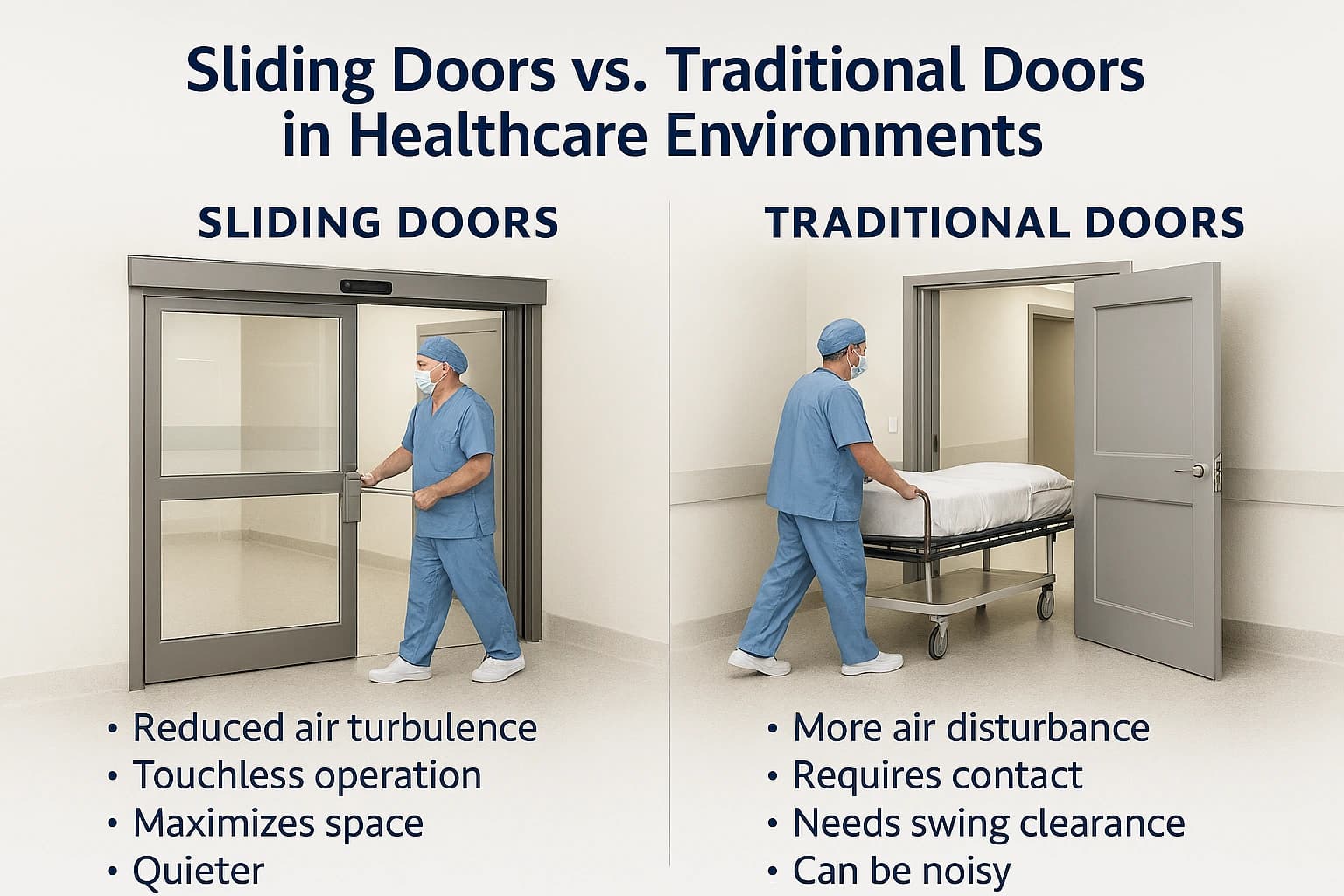
- Reduce airborne contamination: Studies in isolation rooms show sliding doors create significantly less airflow disturbance than hinged doors during opening and passage, lowering the risk of pathogen spread. [healthdesign.org]
- Fewer door openings & faster transit: Automatic sliding doors reduce unnecessary door cycles, which are directly associated with increased bacterial contamination in operating rooms. [ajicjournal.org]
- Hermetic sealing options: Sliding doors can be engineered with airtight seals for ORs, ICUs, and isolation rooms, supporting positive or negative pressure requirements. [dortek.com], [assaabloye...trance.com]
- Touchless operation: Automatic sliding doors minimize hand contact, a key factor in reducing healthcare‑associated infections (HAIs). [assaabloye...trance.com]
✅ Advantage: Sliding doors
Traditional Hinged Doors
- Higher air turbulence: Swing motion displaces larger air volumes, increasing particulate movement across thresholds. [healthdesign.org]
- High‑touch hardware: Handles and push plates increase surface contamination risk unless paired with automatic operators.
⚠️ Limitation: Hinged doors
2. Safety & Emergency Egress
Sliding Doors
- Breakaway configurations allow panels to swing open in emergencies, meeting life‑safety requirements when properly specified. [healthfaci...elines.com]
- Obstacle‑free openings reduce collision risk for beds, equipment, and staff in urgent situations. [dortek.com]
⚠️ Must be specified correctly for fire‑rated and egress paths.
Traditional Hinged Doors
- Code‑familiar for egress: Swing doors remain the default for many patient rooms because they are well understood by staff and inspectors. [healthfaci...elines.com]
- Reliable during power failure: Manual operation is inherently fail‑safe.
✅ Advantage: Hinged doors (simplicity & code familiarity)
3. Space Efficiency & Workflow
Sliding Doors
- No swing radius required, preserving corridor width and usable room space—critical in tight ICU and patient care areas. [dortek.com]
- Improved patient transport: Easier movement of beds, stretchers, and large equipment with fewer bottlenecks. [sonha.com]
✅ Major advantage in modern hospitals
Traditional Hinged Doors
- Door swing can obstruct corridors, which FGI guidelines explicitly warn against in high‑traffic areas. [healthfaci...elines.com]
- Requires wall clearance and careful planning in compact layouts.
⚠️ Limitation: Hinged doors
4. Accessibility & ADA Compliance
Sliding Doors
- Naturally ADA‑friendly: Automatic sliding doors provide hands‑free access for patients using wheelchairs, walkers, or gurneys. [iccsafe.org]
- Preferred at main entrances, emergency departments, and procedural zones. [assaabloye...trance.com]
✅ Advantage: Sliding doors
Traditional Hinged Doors
- Can be ADA‑compliant only with operators or low‑energy openers, adding cost and maintenance. [iccsafe.org]
⚠️ Conditional advantage
5. Noise Control & Patient Experience
Sliding Doors
- Quieter operation and fewer slamming events, supporting healing environments and patient privacy. [dortek.com]
- Can achieve high acoustic ratings with drop seals and specialized frames. [specadsystems.com]
✅ Advantage: Sliding doors
Traditional Hinged Doors
- Slamming and latch noise are common unless dampers are installed.
- Acoustic performance depends heavily on door closers and seals.
6. Cost, Durability & Maintenance
Sliding Doors
- Higher initial cost due to automation, sensors, and controls.
- Lower long‑term wear: No hinges or closers under constant stress; reduced door damage from beds and carts. [dortek.com]
Traditional Hinged Doors
- Lower upfront cost.
- Higher maintenance in high‑use areas due to hinge wear, closer failure, and impact damage. [dortek.com]
⚖️ Cost trade‑off depends on usage intensity
7. Regulatory & Design Standards
- FGI Guidelines (2022) allow both door types but emphasize:
- Infection control
- Corridor clearance
- Emergency access
- Pressurization requirements
[fgiguidelines.org], [digitalass...ission.org]
- Sliding doors are increasingly favored in ORs, ICUs, isolation rooms, and diagnostic areas, while hinged doors remain common in standard patient rooms. [healthfaci...elines.com]
Summary Comparison
Sliding Doors vs. Hinged Doors
Infection control
✅ Superior
⚠️ Moderate
Airflow disturbance
✅ Low
❌ Higher
Space efficiency
✅ Excellent
❌ Requires swing
ADA accessibility
✅ Inherent
⚠️ Requires operator
Emergency egress
✅ With breakaway
✅ Standard
Upfront cost
❌ Higher
✅ Lower
Long‑term durability
✅ High
⚠️ Variable
Bottom Line
Sliding doors are generally superior in high‑acuity, high‑traffic, and infection‑sensitive healthcare areas, while traditional hinged doors remain appropriate for lower‑risk patient rooms and cost‑sensitive applications.
Best Practice in Modern Healthcare Design:
- Sliding doors → ORs, ICUs, isolation rooms, EDs, imaging, main corridors
- Hinged doors → Standard patient rooms, staff offices, low‑traffic spaces
Written by
Get the next article delivered straight to your inbox.
We hate spam too and promise to respect your inbox.