How is FGI changing in 2026

The 2026 FGI Facility Code is more than a routine update, it’s a signal that healthcare architecture is being asked to solve operational reality: throughput, behavioral health, emergency readiness, and distributed care. Here’s what to prioritize now to reduce risk, protect budgets, and keep projects moving.
FGI Facility Code 2026: What Healthcare Facility Leaders Should Do Now (Before Design Starts)
Key takeaways
- Plan earlier. The biggest “code surprises” are really programming surprises.
- Design for flow. Discharge, patient movement, and staff workflows are now space drivers.
- Behavioral health is core infrastructure. Safety, dignity, and sightlines shape design requirements.
- Readiness requires real rooms. Incident response is being formalized as built space.
- Rural and regional systems have unique pressure. Flexibility and mobile care are no longer edge cases.
“In 2026, the most expensive healthcare design mistakes aren’t aesthetic, they’re operational.”
Why this matters in 2026: code is catching up to how care actually happens
Healthcare facilities are being redesigned in real time, by outpatient migration, workforce constraints, rising behavioral health demand, and a growing expectation that hospitals must stay operational during disruption. The 2026 Facility Guidelines Institute (FGI) Facility Code reflects this shift, with updates that read less like preferences and more like a response to frontline operational reality.
For project owners, the lesson is straightforward: the earlier your team aligns programming, operations, and compliance, the less you pay later in redesign, change orders, and schedule loss.
What’s changing (and what planners should do about it)
1) Discharge is being designed as a destination, not an afterthought
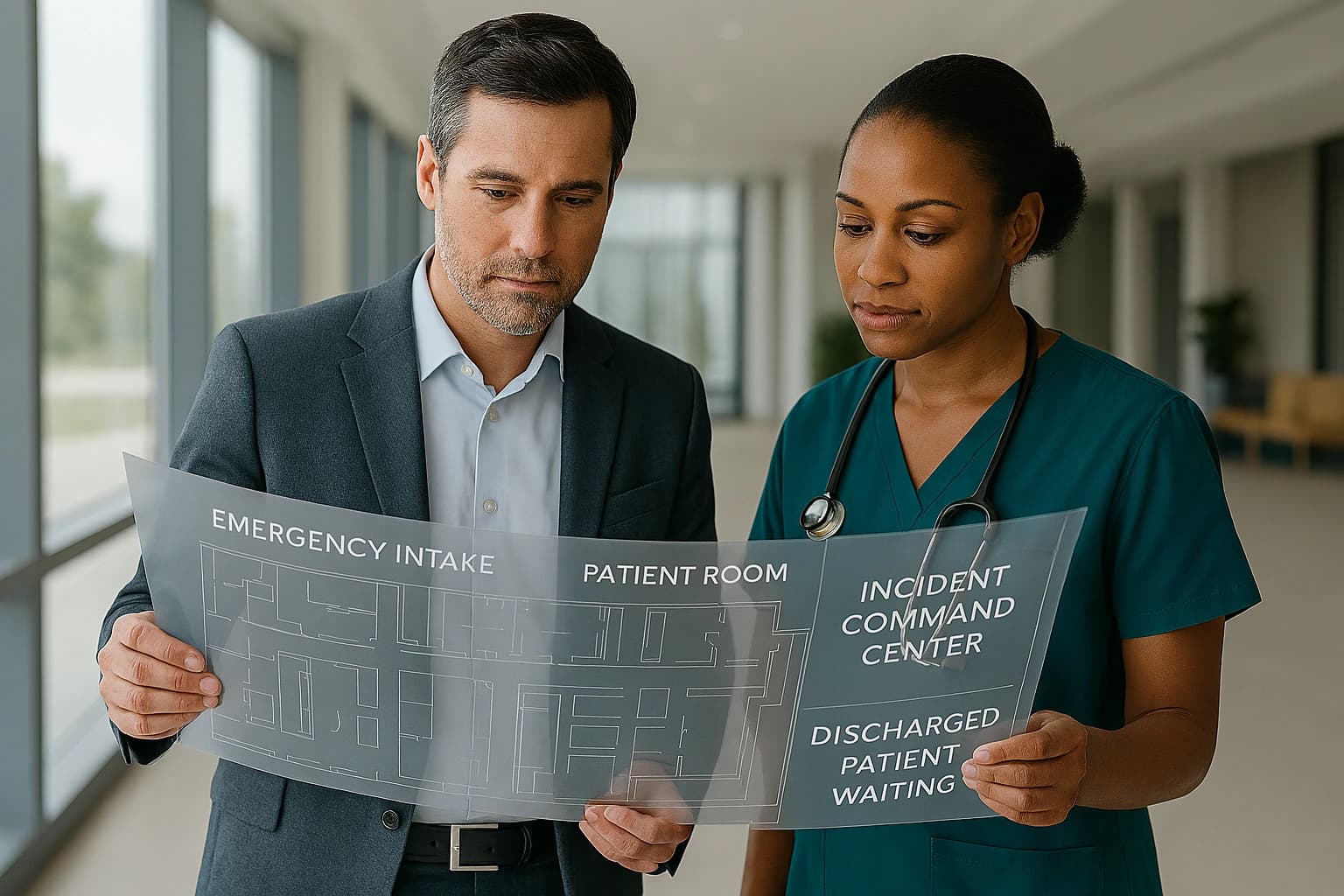
Hospitals have long known the throughput pain: medically cleared patients waiting in inpatient rooms because transportation, instructions, or pickup isn’t ready. The 2026 direction formalizes “discharged patient waiting” spaces, an architectural solution to an operational bottleneck.
What to do now:
- Map your discharge workflow (pharmacy, transport, family pickup, paperwork) and quantify delay points.
- Program a discharge lounge sized to your peak pattern, not your average day.
- Design for visibility plus dignity: clear staff sightlines, comfortable seating, daylight when possible, and a patient experience that feels like “next step,” not “holding.”
“Discharge is the last impression patients take home. It deserves a real place.”
2) Behavioral health is no longer peripheral, it’s shaping the facility
Behavioral health design is evolving rapidly because demand is rising and environments must balance safety with dignity. The 2026 direction expands and clarifies behavioral health requirements across both hospital and outpatient settings, including crisis response environments and spaces for patients with combined medical and behavioral complexity.
What to do now:
- Integrate behavioral health early, not as “a unit,” but as a patient flow condition that impacts ED, imaging, observation, and inpatient placement.
- Prioritize sightlines and circulation as safety fundamentals (not optional “best practices”).
- Design for de-escalation: sensory aware lighting, clear wayfinding, controlled stimulation, and staff support spaces that reduce risk.
“Behavioral health design is no longer a specialty add-on. It’s a core competency.”
3) Incident response is becoming a room requirement, not a binder requirement
Recent crises exposed a gap: many hospitals ran incident command out of improvised spaces that lacked infrastructure for sustained operations. The 2026 direction formalizes readiness through requirements tied to purpose-built incident command capacity, reinforcing that resilience is physical, not theoretical.
What to do now:
- Confirm your command model (roles, staffing, duration, hybrid or remote participation) and program the space accordingly.
- Coordinate early with IT plus security plus facilities engineering so power, communications, and access control support real-world use.
- Design for dual use: a room that provides daily value but can “flip” fast during emergencies.
4) Rural and regional systems: flexibility is your biggest risk reducer
In the Midwest and Mountain West, projects are often constrained by capital, workforce, and distance. The 2026 drafts explicitly acknowledge facility types and designations that matter to rural communities, like rural emergency hospitals (REHs) and critical access hospitals (CAHs), and they strengthen guidance around mobile and distributed care models.
What to do now:
- Design for staffing realities: right-size support spaces and reduce wasted steps with lean adjacencies.
- Build flexible acuity zones: spaces that can shift between observation, infusion, procedure prep, and surge use.
- Plan for mobile and transportable care: power, access, workflow, and safety considerations should be intentional, not improvised.
“For rural systems, flexibility isn’t a luxury, it’s operational insurance.”
Why projects slip: “code issues” are often programming issues
Most late-stage redesigns are blamed on compliance. But the root cause is usually earlier: a scope that didn’t match operations, a procedure mix that wasn’t validated, or adjacencies that didn’t reflect staff workflow. When programming is done with code awareness, and operational truth, projects accelerate and change orders drop.
Altus’ healthcare-specific process emphasizes listening first, then translating operational needs into functional plans shaped by evidence-based design, LEAN principles, and proactive code integration, so teams don’t end up reacting late when changes cost the most.
What to do in the next 30 days (checklist)
- Run a “Code-Readiness plus Operations” kickoff: define scope assumptions, risk areas, and approval path before design starts.
- Pressure-test throughput: discharge, ED boarding, imaging queues, and patient transport paths.
- Validate your procedure mix: what happens where, now and in year five.
- Define behavioral health scenarios: crisis intake, observation, medical comorbidity, and staff safety needs.
- Confirm resilience requirements: incident command activation, downtime operations, and “must stay on” systems.
Bottom line
The 2026 FGI Facility Code is a signal that healthcare architecture is being asked to carry more operational weight: throughput, safety, behavioral health, and readiness. Organizations that respond early will protect their schedules and budgets, and open facilities that work on day one.
Call to action: If you’re launching a project in 2026 to 2028, schedule a short Programming plus Code-Readiness Workshop. A few hours of early alignment can prevent weeks of redesign later.
FAQ
What is the FGI Facility Code 2026?
The 2026 edition is the next evolution of FGI’s widely adopted minimum design criteria for healthcare environments, written to improve clarity and support enforceable adoption.
Will FGI 2026 affect renovations or only new construction?
Many requirements and expectations become relevant in renovations when clinical functions, patient flow, or major building systems change, especially in regulated care settings.
Which updates are most likely to influence early planning?
Space types tied to operations (like discharged patient waiting), behavioral health environments, and incident command readiness can affect your space list, adjacencies, infrastructure, and budget early, when change is cheapest.
Why is behavioral health a major design driver right now?
Behavioral health demand is rising and safety expectations have sharpened. Facilities increasingly need environments that support stabilization and dignity while protecting staff and other patients.
How should rural hospitals prioritize limited capital?
Target flexibility: design spaces and infrastructure that can shift as volumes, staffing, and care models change, without triggering expensive renovations.
What’s the fastest way to reduce change orders?
Start with operational truth: validate procedure mix, staffing models, and workflow diagrams before schematic design, and integrate code awareness from day one.
Written by
Get the next article delivered straight to your inbox.
We hate spam too and promise to respect your inbox.